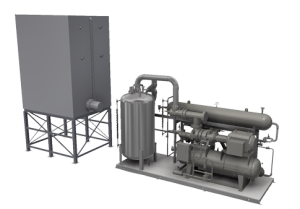
April 22 is Earth Day. Earth Day was founded in 1970 to promote environmental awareness and is celebrated across the world. As more companies continue to “go green,” it’s important to consider energy-efficient options for refrigeration. Refrigeration uses a compressor, condenser, expansion valve, and evaporator. Web.MIT.edu explains the refrigeration process: “Refrigerant flows through the compressor, which raises the pressure of the refrigerant. Next the refrigerant flows through the condenser, where it condenses from vapor form to liquid form, giving off heat in the process…After the condenser, the refrigerant goes through the expansion valve, where it experiences a pressure drop. Finally, the refrigerant goes to the evaporator. The refrigerant draws heat from the evaporator which causes the refrigerant to vaporize. The evaporator draws heat from the region that is to be cooled. The vaporized refrigerant goes back to the compressor to restart the cycle.” One great option for a refrigerant is R717 (ammonia) due to its minimal environmental impact. Ammonia occurring in nature is an inorganic compound created from bacteria processes in soil or from the decomposition of plants and animals. It can also be created artificially. The majority of ammonia produced nowadays is for agricultural uses such as fertilizer, but it is also used in manufacturing, water treatment, and refrigeration. Ammonia is made up of one atom of nitrogen and three atoms of hydrogen (chemical formula: NH3). While the ammonia solution typically used for household cleaning is only 5-10% ammonia, anhydrous ammonia is clear, over 99% pure, lighter than air, and boils at -28°F. Anhydrous ammonia was commonly used for refrigeration in the late 19th century through the early 20th century until chlorofluorocarbons gained popularity. Around thirty years ago, as the true environmental impact of CFCs became clear, several companies began switching back to ammonia for refrigerants. In fact, the International Space Station uses an ammonia system! Ammonia is an excellent choice for large-scale industrial equipment due to its efficiency and low cost. Low-charge ammonia systems, in particular, decrease the possibility of leaks and reduce maintenance needs. These systems have a lower installation cost than traditional systems and are more environmentally-friendly. Low-charge ammonia systems reduce energy consumption and may even qualify for utility rebates. They have an Ozone Depletion Potential (ODP) rating of 0 and a Global Warming Potential (GWP) rating of 0. With the EPA requiring the U.S. to decrease its consumption of HCFCs by 99.5% by 2020, now is a great time to try a low-charge ammonia system. If you’re considering low-charge ammonia chillers, Budzar has several options such as air-cooled or water-cooled condensers. Contact Budzar today to learn more!